Buttery, garlicky kimchi that almost melts in the mouth.
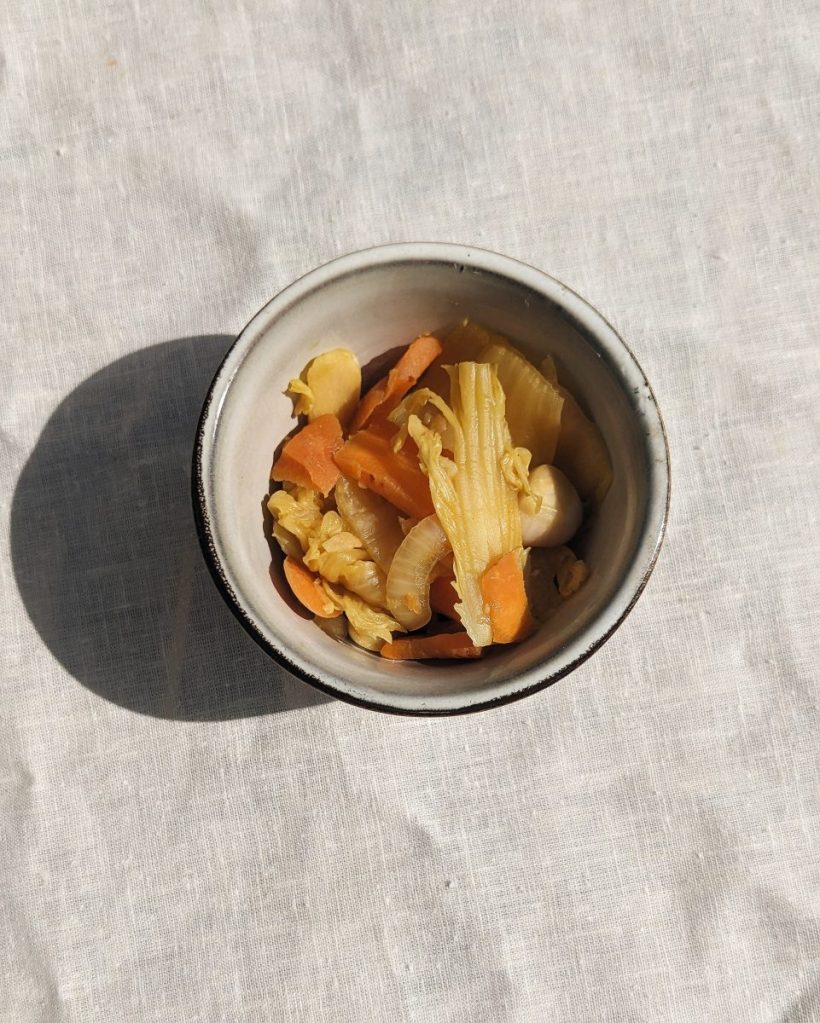
In August 2024, I had the joy of exploring the sun-drenched South of France. For a couple of weeks, a sweltering heatwave settled over the region—thick, still, and unrelenting. In that heavy heat, I had some surprising cravings: I longed for something rich and buttery. Specifically, a smooth, garlicky kimchi that would practically melt in the mouth.
I’ve been making white kimchi for a while now. There’s something beautifully subtle about it—mild and versatile, without the fiery spice of its red cousin. For those of us with autoimmune sensitivities, that gentleness makes all the difference, as it doesn’t irritate a delicate gut lining.
Wanting to give it a bit more punch (and maybe a little extra immune support due to being on the go so much), I decided to adapt my usual recipe. I added a generous amount of turmeric – for its golden glow and anti-inflammatory properties – and upped the garlic. I’d heard garlic might deter mosquitoes, and the ones in Provence that August were big, persistent, and always on the hunt.
After a few days bubbling away on the countertop, the transformation began. The cabbage softened, the flavours deepened, and the brine turned a radiant gold. What emerged was a golden white kimchi—mellow, rich, and totally addictive. Buttery and slightly funky, with a gentle warmth from the garlic and turmeric, it became my go-to batch all summer long.
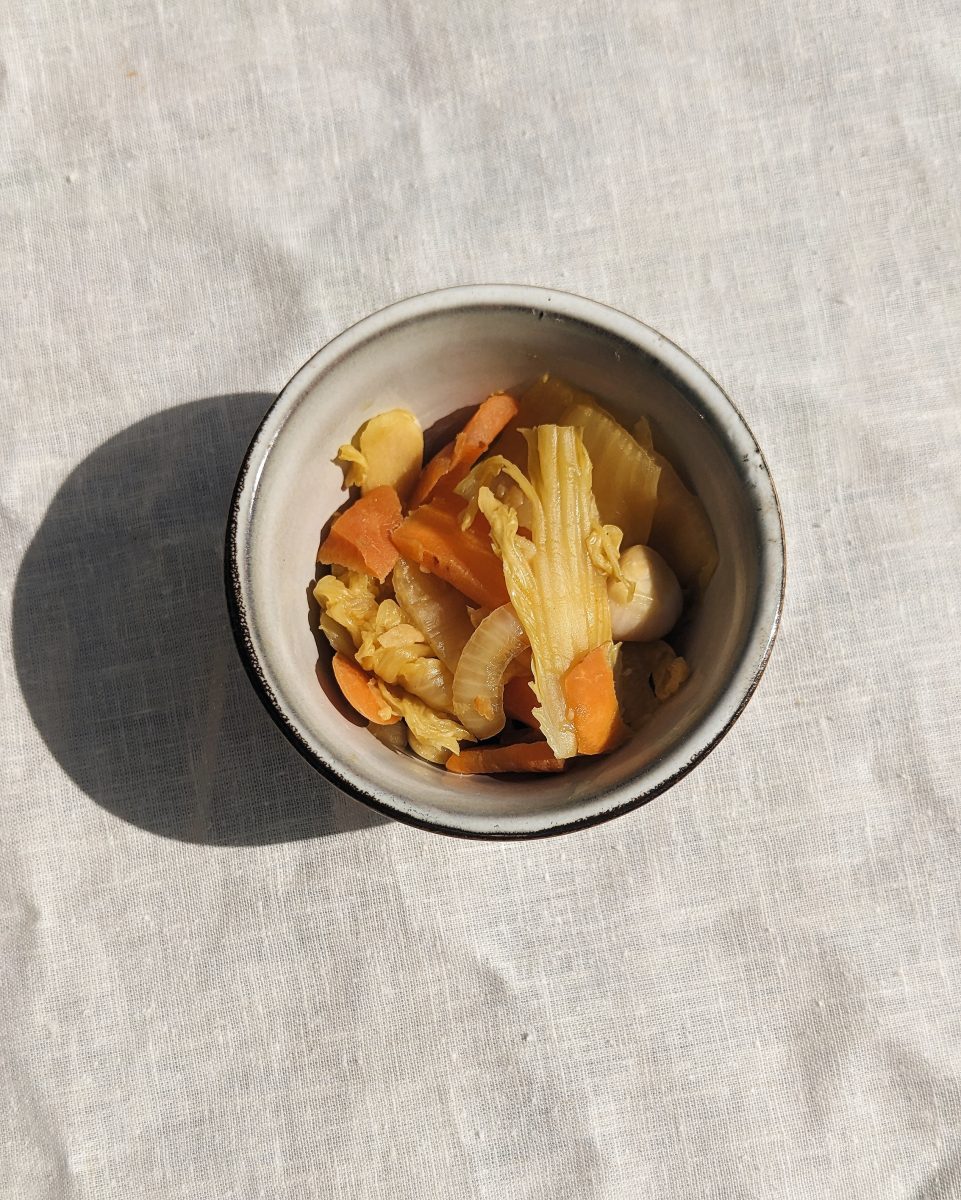
A RECIPE FOR GOLDEN TURMERIC KIMCHI
INGREDIENTS:
- 1 x Napa cabbage
- 1 x thumb size piece of fresh ginger, peeled and then grated or finely chopped
- 1 x handful of garlic cloves, peeled and roughly chopped
- 2 x spring onions, top and bottoms removed and roughly chopped along the lengths
- 2 x medium sized carrots, cut into thin fingers, grated or peeled into strips with a potato peeler
- 1 x tbsp tamari or soy sauce
- 2 x tbsp fish sauce
- 1 x tbsp turmeric powder
- Sea salt
METHOD:
- Remove a few outer leaves from the cabbage.
- Chop in half vertically and then again, vertically, into quarters.
- Remove the heart / core of the cabbage (this can be done by placing your knife at an angle on the inside and slicing towards the outside base of the cabbage – such as in this video).
- Take the cabbage quarters and horizontally slice into strips of your chosen width (I personally like chunky kimchi strips of cabbage, but this is up to you).
- Place your mixing bowl onto your scales and tare so the number is 0g.
- Place the cabbage, carrot, spring onion, garlic and ginger into the mixing bowl and find the weight of your vegetables.
- Find 2% of the weight ~ this is how many grams of salt you will need (if your vegetables weighed an even 1000g then 2% of the weight would be 20g. This can also be done by taking the weight and multiplying it by 0.02 on a calculator).
- Add the weight of sea salt you need to your vegetables.
- Mix the salt through the vegetables and let it stand for 5 minutes for the salt to draw out some of the liquid.
- With clean hands, start to toss everything in the bowl and rub the salt into vegetables.
- Keep mixing and massaging the salt into the veg until everything starts to get very liquidy. You can get a bit rough here and crunch and punch everything in your bowl until you get the right consistency.
- You will know it’s ready when you can grab a handful of vegetables in one hand, squeeze it above your bowl and a if line of liquid runs back down into the bowl, you’re good to go.
- Add the tamari / soy sauce, half the fish sauce and half the turmeric powder to the bowl and mix together with a spoon (this saves your hands from being turmeric and fish sauce stained).
- Taste the veg ~ it should taste as good going into the jar as it does coming out of it.
- Add the remaining fish sauce and / or turmeric if you would like.
- Using the spoon, start to pack the veg into the kilner jar. Tightly pack it down with every spoonful.
- Keep going until the jar is nearly full to the brim. Make sure to leave a 2.5cm / 1 inch gap at the top of the jar for breathing space.
- Try and get the vegetables sitting under the liquid and if you have fermentation weights you can add these to the top of the jar. Alternatively a large rolled cabbage leaf (one you took off at the beginning) can work to help to hold the veg down.
- Leave in a warm place to ferment for the next few days, opening the jar once a day to let the build up of gasses out.
- Taste test on day 3 ~ if you’re happy with how it tastes enjoy and transfer to the fridge to be eaten within the next month or so.
- If you would like to keep the fermentation process going, leave the jar on the side and keep opening (burping) the jar every now and then and tasting it until you are happy with the result.


One of the things I love most about fermented foods is their ability to unlock nutrients and make them more bioavailable to the body. Fermenting turmeric, in particular, feels like a bit of a golden hack. It enhances the absorption of curcumin – the vibrant orange compound that gives turmeric its colour and many of its benefits, but which is notoriously hard for the body to absorb in its raw form.
Curcumin is widely celebrated for its potent anti-inflammatory and antioxidant properties, offering deep, nourishing support to the body – especially when gently activated through fermentation.
In the intense summer heat of Provence, this kimchi fermented quickly, reaching its fizzy, golden peak in just three days. In cooler climates, I’ve found it typically takes closer to seven days to develop that same brightness, tang, and complexity.

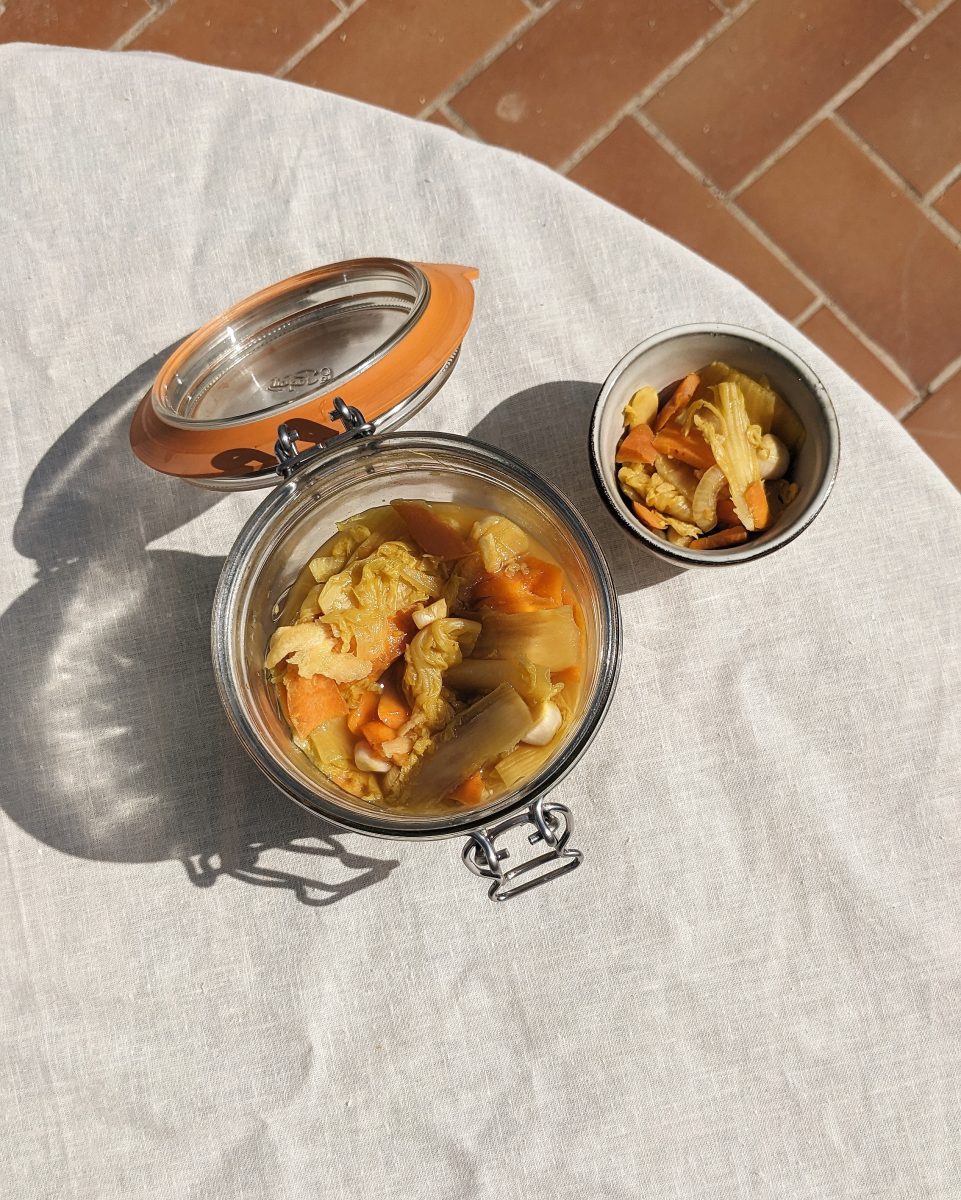
This kimchi became a versatile companion to so many meals: I layered it on sourdough pancakes, tossed it into fried rice, and even played with it in a fermentation experiment for rice paper rolls (the batch with this golden kimchi was the clear winner in the flavour test). Sometimes I would simply spoonful straight from the jar. It was that good. I would forgot just how velvety and smooth it was, and every time I opened the jar, was delighted by the buttery surprise.
The last spoonful from my first jar, enjoyed while standing barefoot in the garden in Provence at sunset, was a bittersweet moment. It reminded me of that fleeting feeling at the end of summer – when you’re sad that it’s over, grateful for the memories, and hopeful that the next one will be just as sweet.
I hope you enjoy xx

 FLEURMENTATION